The Barbarian Beneath the Brand: How Conan and Frank Frazetta Shaped He-Man
The Barbarian Beneath the Brand: How Conan and Frank Frazetta Shaped He-Man
When the official teaser trailer for the 2026 He-Man dropped today, it reignited a conversation that has followed the character since his inception. He-Man may be branded as a toy-born icon, but his origins reach far deeper than plastic and into the visual language of heroic fantasy that defined an era. To understand He-Man honestly, you have to look not just at Mattel, but at Conan, and at the artist who gave Conan his modern face: Frank Frazetta.

By the late 1970s, Mattel was actively trying to reposition itself after turning down the opportunity to produce Star Wars action figures. The company needed a new, male-centric toy line, something bold enough to compete in a rapidly shifting market. Internally, Mattel began developing concepts that blended fantasy and science fiction, a direction formalized in a 1980 internal proposal titled Fantasy Make Believe.

Authored by Roger Sweet, the document explicitly called for figures inspired by sword-and-sorcery traditions, while also allowing room for futuristic elements. Notably, the proposal references Conan alongside Flash Gordon and Star Wars, revealing that barbarian fantasy was not an afterthought. It was the foundation. That foundation mattered because barbarian fantasy didn’t exist in a vacuum.
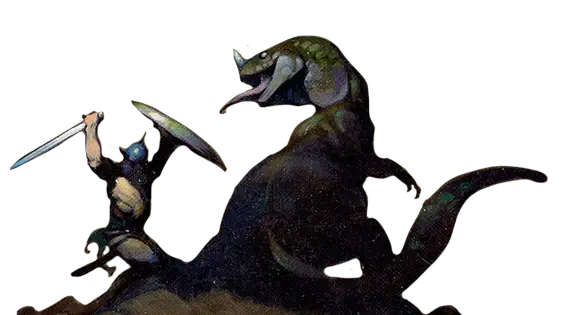
By that point, Conan the Barbarian was already a cultural force, and visually, that force was inseparable from Frank Frazetta. Frazetta’s paintings had done more than illustrate Robert E. Howard’s character; they had standardized what a barbarian hero looked like in the modern imagination. Monumental physiques, minimal armor, primal confidence, and a timeless mythic setting, Frazetta turned Conan into an archetype that extended far beyond literature. Mattel’s early development reflected that reality.
Even while He-Man was already in concept development, the company pursued and briefly obtained the rights to produce action figures based on the upcoming Conan the Barbarian film. That decision alone underscores how central Conan, and by extension Frazetta’s visual legacy, was to Mattel’s thinking. But when the studio saw the film’s level of graphic violence, the license was withdrawn. Once again, Mattel lost the name, not the appeal and what followed was not invention so much as recalibration.

He-Man emerged as a legally distinct character who preserved many of the visual and mythic components that had already proven powerful: the bare chest, the fur or loin-cloth-style costume, exaggerated musculature, weapon-based iconography, and a world untethered from historical specificity. The science-fantasy elements, lasers, vehicles, cosmic villains, were layered on deliberately, not to replace the barbarian core, but to broaden the universe and create legal distance and Eternia became the solution. It’s important to be precise here. He-Man is not Conan, and Mattel did not copy a single character wholesale. But the barbarian archetype He-Man inhabits was already visually codified, and that codification came largely from Frazetta.
Designers like Mark Taylor and Roger Sweet were not copying individual paintings; they were working inside a visual grammar that had already been written. When Frazetta’s influence appears invisible, it’s because it had become foundational. That foundation held even as Masters of the Universe leaned further into kid-friendly storytelling. Bright colors, moral clarity, and cosmic spectacle softened the edges, but the figure at the center never stopped being a barbarian. Strip away the dialogue and animation style, and He-Man still stands exactly as a Frazetta hero would. The irony is that He-Man ultimately surpassed Conan in reach, especially among younger audiences. Entire generations grew up fluent in Frazetta’s visual language without knowing his name, mistaking inheritance for originality. That isn’t a failure of credit, it’s simply put, the mark of cultural absorption. When an artist’s work becomes atmosphere, it no longer needs attribution to function.

What makes this new 2026 teaser trailer so interesting is its apparent willingness to reconnect with that lineage. It feels like an acknowledgment of something the franchise has always understood but rarely stated outright: He-Man’s strength doesn’t come from reinvention, instead, it is coming from continuity.
Frank Frazetta never worked on He-Man, and Conan remains Conan, his own literary and cinematic legacy, one we work closely with and deeply respect. But Frazetta created the iconic look that allowed barbarian fantasy to migrate so seamlessly from book covers to toys, television, and now modern cinema. He-Man wasn’t born in a boardroom alone, he was born in the long shadow of an artist who understood that myth, once drawn correctly, doesn’t disappear. It wonderfully adapts, evolves and waits until a new generation is ready to see where it truly came from.
-Sara Frazetta

Explore Frank Frazetta’s Conan
Discover Frazetta’s Conan artwork and merchandise in the Conan collection, including the Conan the Barbarian print and available Conan 5.5-inch retro action figure.