When Conan Found His Form: From Pulp Prose to Cultural Permanence
When Conan Found His Form: From Pulp Prose to Cultural Permanence
In December 1932, Robert E. Howard introduced Conan in the pages of Weird Tales. On the page, the character was velocity: steel flashing, blood splattering, footsteps cutting across ruined kingdoms. Howard wrote in verbs and he built atmosphere through cadence and force. What he did not fix was an image. Early pulp illustrators offered interpretations, but none imposed a lasting authority for the visual of Howard’s barbarian. For decades, Conan remained fluid, anchored in language and completed in the reader’s imagination.

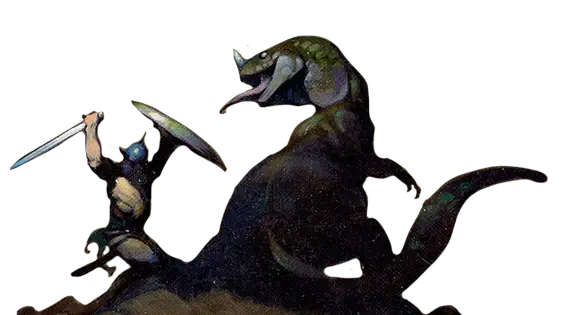
The transformation arrived in the 1960s with the rise of mass-market paperbacks. Reprints did more than preserve Howard’s stories; they completely reframed them. One painting had to communicate tone and identity in a single glance. When Frank Frazetta began painting Conan for the Lancer editions in 1966, the character crossed from prose into form. A body compressed with tension. A blade carried as if it had already been used. A posture suggesting aftermath rather than anticipation. These were structural decisions and from that moment forward, Conan was no longer interpretive. He was defined. The significance of that shift was cultural. Through wide circulation, those covers traveled beyond bookstores, into dorm rooms, comic shops, and eventually film. By the time Marvel launched Conan the Barbarian in 1970, the image had already settled into public consciousness. Later screen adaptations inherited a figure audiences recognized instantly. That is the threshold between a character and an icon: recognition without explanation.

In paintings such as Conan the Adventurer (1966), the body became narrative surface. Musculature suggested endurance. Light cut sharply across flesh. Background elements receded into atmosphere rather than distraction. The scene implied consequence rather than spectacle. Critics would later describe these works as monuments to physical power, and that assessment holds. They felt less like disposable cover art and more like epic painting compressed for a commercial format. Over time, institutions and collectors treated them accordingly. What began as utilitarian packaging was reassessed as foundational to modern fantasy art. Their endurance rests on formal intelligence. Frazetta worked with mass, tonal contrast, and gesture. The image registered immediately, even on inexpensive stock, yet retained depth under scrutiny. It was engineered for reproduction without sacrificing authority. The influence moved outward.

In comics, Frazetta altered construction itself. Figures were expected to command space before they spoke. Composition privileged weight and shadow over decorative detail. Even artists who did not consciously emulate him absorbed that recalibration. Fantasy protagonists were no longer merely illustrated; they were staged. Film drew a related lesson. Cinema required atmosphere as much as costume design. The 1982 Conan the Barbarian reflected that density. With Fire and Ice (1983), the translation became direct: rotoscoping sought to approximate the anatomical realism and physical tension characteristic of his work. It was not homage for its own sake, but adaptation of a visual logic already proven effective. Contemporary fantasy, particularly in gaming and concept art, continues to operate within this framework. Modern character design depends on immediate legibility at small scale. Bold forms, controlled contrast, and decisive staging, principles refined for the paperback rack, remain central to the field.
Frazetta’s solutions proved adaptable, surviving the transition from oil to digital rendering. Yet for decades, classic fantasy art existed precariously. Printed on acidic paper and treated as disposable, it was rarely preserved with institutional seriousness. Protecting it is not indulgence; it is corrective scholarship. These images shaped the visual vocabulary of comics, film, and interactive media. To encounter them only through degraded reproductions is to miss their precision. Stewardship therefore becomes part of the historical record. Careful curation, faithful reproduction, and contextual scholarship restore authorship and intent. Within that effort, our legacy company, Frazetta Girls, has played a measured role, less as promoter than as interpreter, situating the Conan-era paintings within broader discussions of influence, reproduction, and cultural transmission. The aim is not to entomb the work in reverence, but to ensure it remains legible within contemporary discourse.
Conan’s evolution, from prose in 1932 to consolidated visual authority in 1966, offers a case study in how cultural permanence is constructed. It requires decisive interpretation, broad circulation, and sustained preservation. Frazetta gave Conan a physical certainty the culture adopted without hesitation. Continued scholarship ensures that certainty is understood not as accident, but as deliberate artistic achievement.